
πŸ€– Duc-Cuong VU, BSc.

E-mail / ORCID / LinkedIn / Google Scholar / GitHub / CV

✍️ about me

I am pursuing an M.Sc. in Automation and Control at HUST, supervised by Assoc. Prof. Dr. Tung Lam Nguyen. My research focuses on Stewart platforms in marine environments, funded by VINIF. I hold a B.Sc. from HUST and received the Best Thesis Defense Award for my work on balancing, motion planning, and tracking control for ballbot systems.

Beside that, I am a Robotics Engineer at VinRobotics, working on control algorithms and motion planning for humanoids and industrial robots.

My interests include control theory, robotics, and bridging simulation with real-world validation. See my projects and activities for more.
Duc-Cuong Vu image
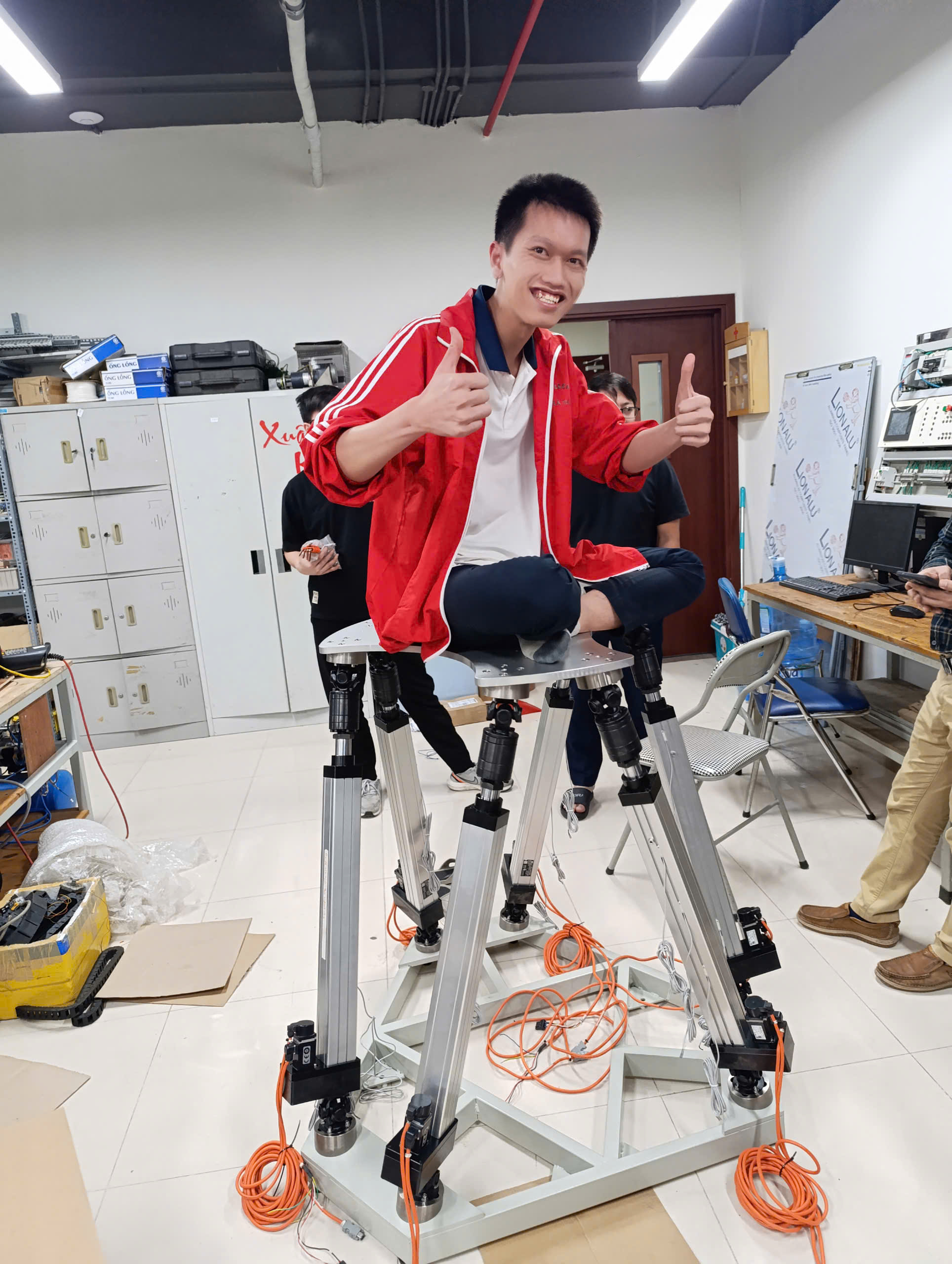
πŸ“· My photo with the 6-dof parallel robot, Stewart platform, at Motion Control and Applied Robotics laboratory (MoCAR), C7-building, Hanoi University of Science and Technology (HUST).

πŸ“£ news

[Jan 13, 2026] With VinRobotics control teams, we submitted two papers to Forcused Section on TMECH/AIM.
[Sep 17, 2025] My work for HUST project is accepted for publication in Ocean Engineering πŸŽ‰.
[Sep 08, 2025] Thrilled to begin a new chapter at VinRobotics! πŸŽ‰
[Jul 07, 2025] Our ship-mounted Stewart platform paper is accepted for publication in Ocean Engineering πŸŽ‰.
[May 28, 2025] My project with VinIF, related to my master's course, was completed with high appropriateness βœ….
[May 20, 2025] An Autonomous-Underwarter-Vehicle-related manuscript is submitted to Ocean Engineering 🌊.
[Apr 16, 2025] A paper, forcusing on Ship-mounted Stewart platform, is submitted to Ocean Engineering 🌊.
[Mar 27, 2025] Our paper on ballbot was accepted for publication in IEEE Access πŸŽ‰.
[Dec 30, 2024] Our paper on Stewart Platforms was accepted for publication in Results in Engineering πŸŽ‰.
[Sep 12, 2024] I am delighted to announce that I have decided to receive the VinIF scholarship for my master's course under a project πŸ’°.
[Jul 01, 2024] I started my Master of Science in Automation and Control at HUST πŸŽ“.
[May 11, 2024] I graduated with a Bachelor of Science in Automation and Control from HUST πŸŽ“.
[Mar 27, 2024] Our paper on ballbot was accepted for publication in International Journal of Robust and Nonlinear Control (IJRNC) πŸŽ‰.

πŸ“š selected publications

TMECH/AIM
HIK-paper

πŸ“ Conformal-Seeded Hybrid Inverse Kinematics for Offset Redundant Manipulators

Duc-Cuong Vu, Van Tung Nguyen, Duc Hai Nguyen, Manh Cuong Nguyen, Tran Vu Trung, Andreas Kugi, and Minh Nhat Vu

submitted to TMECH/AIM Focused Section
Ocean Eng.
Ocean Engineering

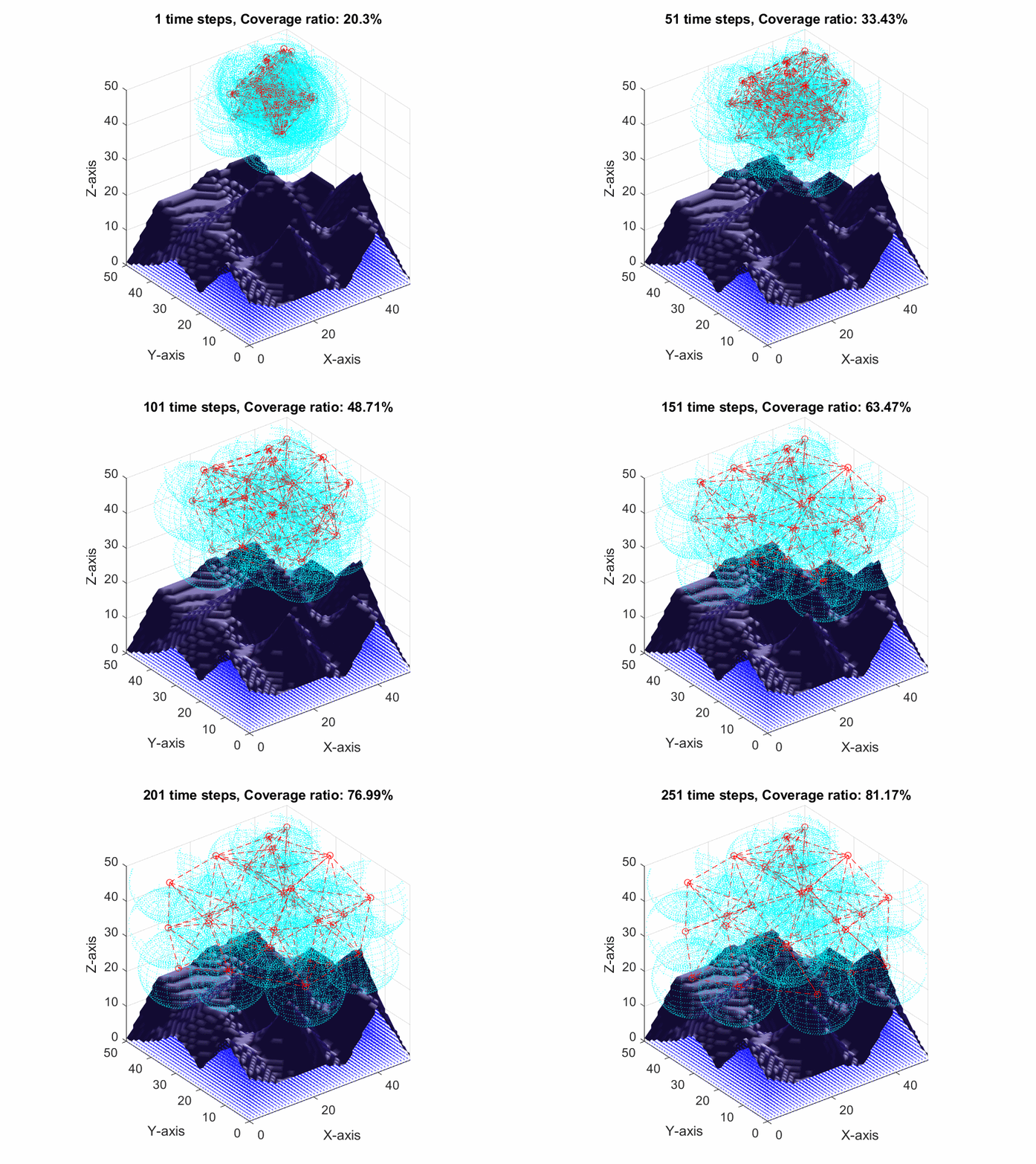
πŸ“ Glocal trajectory generation and tracking control for AUVs with optimal coverage sensor networks

Duc Cuong Vu*, Son Tran*, Tung Lam Nguyen, and Duc Chinh Hoang

* equal contribution

Ocean Engineering, 2025 (SCIE, Q1)
[paper | pdf | code]

This paper presents a comprehensive framework for glocal trajectory generation with real-time tracking control for a group of Autonomous Underwater Vehicles (AUVs) equipped with distributed sensors. A two-stage approach is proposed to maximize the underwater area coverage of sensor systems while ensuring network connectivity between AUVs and free collision with terrains and floating obstacles. At the global level, a heuristic algorithm named Global Trajectory to Maximize Coverage (GT-MC) is introduced, which generate trajectory to optimize the final AUVs distribution. After that, the trajectory is further optimized to produce the final set of waypoints for the AUVs group. At the local level, a safety-critical trajectory generation method is developed by using a Model Predictive Control (MPC) scheme for a virtual AUV system with Control Barrier Functions (CBF) as constraints for floating obstacle avoidance. Then, the generated trajectories are tracked by the actual AUVs using a base controller, in this case a classical Sliding Mode Controller (SMC) combined with a thruster force allocation optimizer. The complete framework is validated via simulation studies using an open-source advanced physics tool called MuJoCo. The suggested methodology can facilitate the autonomy, scalability, and safety of sensor-AUVs distribution missions, making it a promising tool for intelligent marine sensing and monitoring.
Ocean Eng.
Ocean Engineering

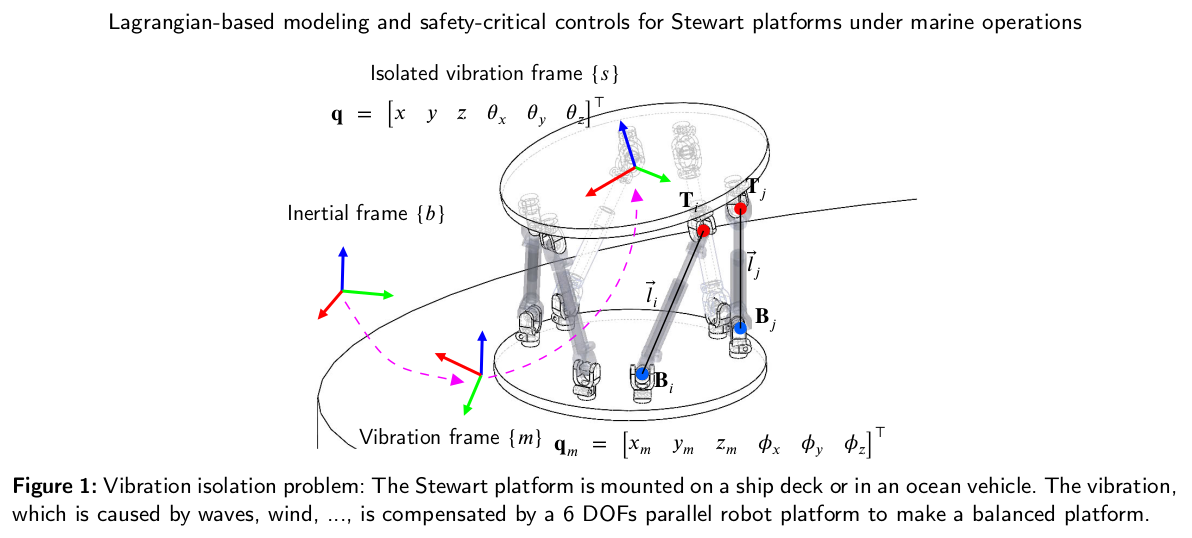
πŸ“ Lagrangian-based modeling and safety-critical controls for Stewart platforms under marine operations

Duc Cuong Vu, Danh Huy Nguyen, Minh Nhat Vu, and Tung Lam Nguyen

Ocean Engineering, 2025 (SCIE, Q1)

[paper | pdf]

The operation of waves, winds, and ocean currents that affect ships or marine vehicles poses a number of challenges for systems that require balance. To address this issue, this study introduces a 6-degree-of-freedom parallel robot Stewart platform erected on the ship deck to isolate vibrations. First, Lagrangian-based modeling is applied to the ship-mounted Stewart platform. Unlike previous systems that are based on Kane’s method or Newtonian mechanics, the Lagrangian-based approach does not require a large number of tedious mathematical transformations; instead, it can be generated by a computer. Because of the complexity of the simulation model, the control design model is simplified from the original. Following that, the Control Lyapunov Function (CLF) is employed to achieve zero convergence and the stabilization of the state errors. To ensure operational safety, the Quadratic Program (QP) problem takes into account the Control Barrier Function (CBF) and Exponential Control Barrier Function (ECBF) constraints. The controllers are equipped with High-Gain Disturbance Observation (DOB). Finally, the Lagrangian-based model is validated by comparison with the MATLAB Simscape Multibody platform. In addition, the performance of the proposed control strategies is analyzed.
IET Cyber-Syst. Robot.
IET publication

πŸ“ Unifying Hierarchical Sliding Mode Control and Control Barrier Function for Tilt Angle Constraint of a Ball-Balancing Robot

Thi Thuy Hang Nguyen, Duc Cuong Vu, Minh Duc Pham, Tung Lam Nguyen, and Thi-Van-Anh Nguyen

IET Cyber-Systems and Robotics, 2025 (SCIE, Q3)

[Accepted manuscript]
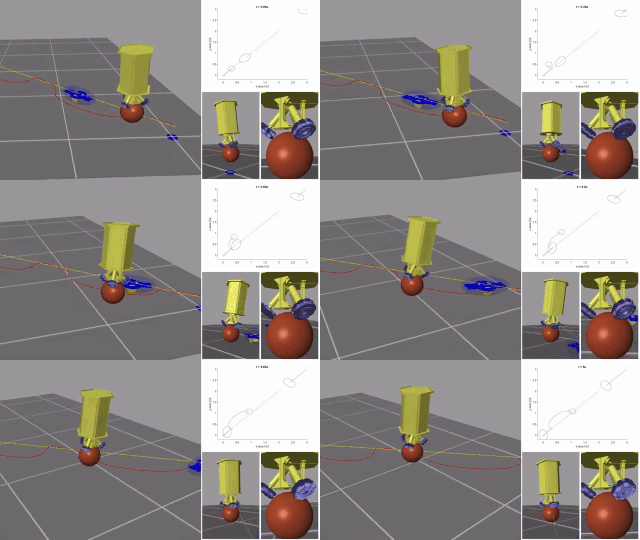
This paper presents a novel control methodology that combines control barrier functions (CBFs) and hierarchical sliding mode control (HSMC) for the ball-balancing robot. The motivation arises from the need to achieve stable balancing and position tracking while guaranteeing physical safety under tilt angle constraints. The proposed approach aims to achieve stable balancing and position tracking, and ensure compliance with safety constraints defined as an invariant set. To ensure the satisfaction of these safety constraints, CBFs are employed. Based on the construction of a suitable CBF, a non-empty set of control signals satisfying the CBF-dependent inequality is given. The integration of CBFs and HSMC is facilitated through quadratic programming (QP), enabling the unification of stability objectives and safety constraints. The applied nominal control law is HSMC, an effective solution for the underactuated system. The safety constraint is considered to guarantee that the tilt angle of the body never exceeds a predetermined value. Simulation results demonstrate that the proposed controller maintains the deviation angle within safe bounds while achieving robust tracking performance. These findings confirm the potential of combining HSMC with CBFs to ensure both performance and safety, paving the way for future experimental validation on physical platforms.
IEEE Access
IEEE Access

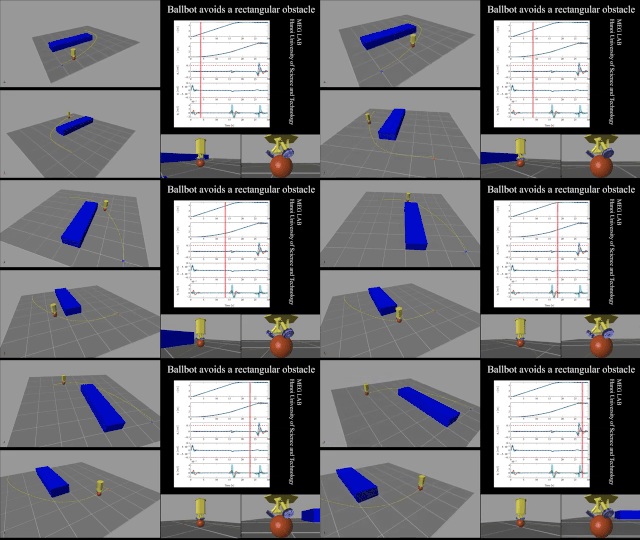
πŸ“ CBFs-based Model Predictive Control for Obstacle Avoidance with Tilt Angle Limitation for Ball-Balancing Robots

Minh Duc Pham, Duc Cuong Vu, Thi Thuy Hang Nguyen, Thi Van Anh Nguyen, Minh Nhat Vu, and Tung Lam Nguyen

IEEE Access, 2025 (SCIE, Q2)
[paper | pdf]

This study investigates an automatic navigation method for one type of underactuated system, ball-balancing robot (ballbot), in complex environments with both dynamic obstacles and complex-shaped obstacles. To ensure safe operations, which means that ballbot has to avoid obstacles and maintain tilt angles in a desired range, Nonlinear Model Predictive Control (NMPC) is formulated to predict the position and behavior of the ballbot, followed by the optimization problem assisted by Control Barrier Function (CBF) constraints to drive the ballbot in the safe trajectory. Instead of directly implementing tilt angle limitations on the main NMPC, another Quadratic Programming Optimizer based on CBF is designed outside the main controller to reduce the constraint complexity of optimization. An elliptic-bounded generation method is used to simplify the object boundary, especially concave obstacles definition in NMPC constraints, while Extended State Observer is used for observing, compensating the uncertainty terms, and estimating the velocities of the ballbot. In general, by combining this CBF-based NMPC and Quadratic Programming, this research addresses simultaneously high-quality observer, tracking control, balancing control, complex motion planning and safe-angle constraints for the 3D-ballbot system. The effectiveness of our proposed method is determined by simulations in complicated tracking scenarios with static, dynamic and complex-shaped objects.
RinE
Results in Engineering

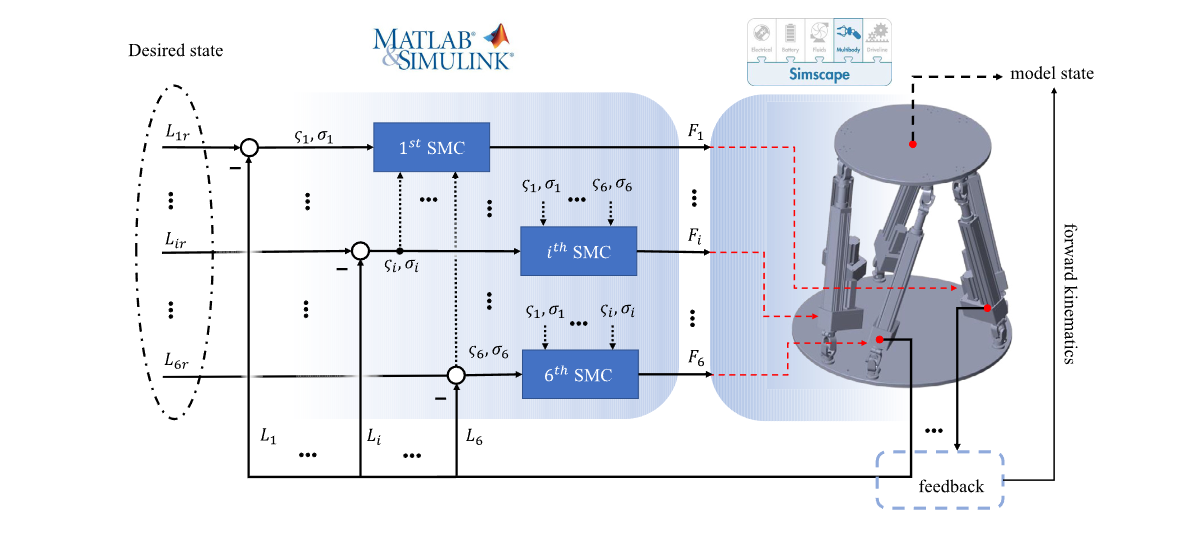
πŸ“ A novel approach of Consensus-based Finite-time Distributed Sliding Mode Control for Stewart platform manipulators motion tracking

Duc Cuong Vu, Danh Huy Nguyen, and Tung Lam Nguyen

Results in Engineering, 2025 (ESCI, Q1)
[paper | pdf]

The Gough-Stewart Platform, often referred to simply as the Stewart Platform, is a parallel mechanical system with six degrees of freedom, which is widely employed in simulation and precise applications. This study gives a thorough Lagrangian-based model of the Stewart Platform, emphasizing its dynamic behavior and control mechanisms. A novel distributed control technique based on Finite-time Distributed Sliding Mode Control (DSMC) is presented to establish second-order consensus in a multi-agent framework in which each leg of the platform is viewed as an autonomous agent. The control approach ensures accurate monitoring of reference trajectories. Simulations are used to validate the efficacy of the proposed control scheme by comparing it to typical decentralized PD control methods. The results simulated based on the Quasi-Physical Model show that consensus-based control outperforms the counterpart control approaches in terms of accuracy and stability.
IJRNC
RNC Journal

πŸ“ Time-optimal trajectory generation and observer-based hierarchical sliding mode control for ballbots with system constraints

Duc Cuong Vu, Minh Duc Pham, Thi Thuy Hang Nguyen, Thi Van Anh Nguyen, and Tung Lam Nguyen

International Journal of Robust and Nonlinear Control, 2024 (SCIE, Q1)

[paper | pdf]

This paper introduces a comprehensive motion planning–tracking–safety constraint scheme for a 3D ballbot system. A nonlinear control for the 3D ballbot system is designed based on three separate planes by utilizing extended state observer (ESO) to estimate coupling mechanisms. Three virtual control signals are generated from these distinct planes and can be used for formulating actual control signals. To overcome the complexity of nonlinear motion equations, flatness theory is used to construct the time-optimal trajectory through an optimization problem, facilitating smooth movement of the ballbot, and obstacle avoidance based on RRT* waypoints. Furthermore, our work manipulates the hierarchical sliding mode controller (HSMC) as the nominal controller to ensure that the ballbot tracks to the optimal trajectory, unifying with the exponential control barrier function (ECBF) to address safety constraints in the body's deflection angle. Through extensive simulations and comparative analysis, the system demonstrates its effectiveness and safe operation in various working conditions.

πŸ’Ό work experience

Robotics Engineer at VinRobotics, Vingroup
Full-time (On-site) | Hanoi, Vietnam
Sep 2025 – Present
  • Responsible for model-based control and motion planning for industrial robots.
VinRobotics Logo
Research Project Assistant at HUST
Contract (Hybrid) | Hanoi, Vietnam
Jan 2025 – Present

Supervised by PhD. Chinh Hoang Duc (PI) and Assoc.Prof.PhD. Tung Lam Nguyen.

Project: Robot navigation system integrating sensor network and wireless communication.
  • Designed and developed a comprehensive MuJoCo-based simulation environment for AUVs, incorporating underwater dynamics, sensor feedback, environmental disturbances, and communication constraints to evaluate system performance.
  • Implemented and validated advanced control algorithms for navigation, obstacle avoidance, and trajectory tracking, while collaborating on integration, troubleshooting, and authoring a peer-reviewed scientific paper.
MEG Logo
HUST Logo
Research Project Assistant at HUST
Contract (Hybrid) | Hanoi, Vietnam
Jan 2025 – Oct 2025 (10 mos)

Supervised by PhD. Minh Nhat Vu (PI) and Assoc.Prof.PhD. Tung Lam Nguyen.

Project: Advanced Control of a Ship-Mounted Stewart Platform for Marine Applications (KIST).

  • Designed and implemented advanced control algorithms for the Stewart platform, including safety-critical and robust control strategies tailored for marine environments.
  • Developed high-fidelity simulation models and conducted comprehensive experimental validation to analyze system performance under marine disturbances.
  • Collaborated with cross-institutional teams on system integration, troubleshooting, and authoring peer-reviewed scientific publications.
MEG Logo
HUST Logo
Graduate Student Research at HUST
Part-time (Hybrid) | Hanoi, Vietnam
May 2024 – Present

Supervised by Assoc.Prof.PhD. Tung Lam Nguyen.

Project: Design control structures for Parallel Platforms in Maritime applications (VinIF).

  • Designed and implemented advanced control algorithms for a Stewart platform in marine environments, supported by high-fidelity simulations (Simscape, MuJoCo) and validated through a full experimental setup (mechanical assembly, hardware integration, Linux real-time kernel, EtherCAT communication).
  • Collaborated with cross-institutional teams on system integration, troubleshooting, and documentation, while authoring peer-reviewed publications and presenting outcomes to academic and industrial partners.
MEG Logo
HUST Logo
Student Intern at HUST
Internship (Hybrid) | Hanoi, Vietnam
Oct 2021 – Apr 2024 (2 yrs 7 mos)

Supervised by Assoc.Prof.PhD. Tung Lam Nguyen.

Project: Balancing, motion planning, and tracking control for ballbot systems.

  • Developed mathematical models and simulation environments for 3D ballbot systems, focusing on nonlinear dynamics, trajectory generation, and safety constraints.
  • Conducted research on modeling and simulation, advanced control strategies, and practical implementation for the Ball-Balancing Robot.
  • Authored and co-authored peer-reviewed journal papers based on the project outcomes, including publications in the International Journal of Robust and Nonlinear Control (RNC) and IEEE Access.
MEG Logo
HUST Logo

πŸŽ“ educations

⭐⭐ Master of Science in Automation and Control
Jul 2024 – Present
HUST
⭐ Bachelor of Science in Automation and Control
Oct 10, 2020 – Apr 04, 2024
  • CPA: 3.71/4.0 (Excellent degree). Rank: 22/499
  • Thesis: Balancing, motion planning and tracking control for ballbot systems (The best thesis defense) [pdf]
HUST